
If you are sourcing pipe supports for yachts, workboats, offshore platforms, aquaculture systems or coastal saltwater piping, the marine U bolt pipe clamp is usually the cheapest line on the drawing — and the one most likely to fail first. A wrong grade, a missing liner, or a loose nut can end in pitted bolts, abraded pipe, leaked joints and survey findings.
This guide covers what to specify, what to verify, and what to ask before you buy.
H2: Why Ordinary U Bolt Clamps Fail in Saltwater
General-purpose clamps are not interchangeable with marine-grade ones. Three mechanisms do most of the damage.
Crevice Corrosion
Saltwater trapped in the gaps between the U bolt, the pipe and the liner creates low-oxygen micro-zones. Chlorides break down the passive oxide layer, and pitting starts in exactly the place you cannot see. Even 304 stainless can pit within months of continuous salt exposure.
Galvanic Corrosion
When two dissimilar metals touch in wet, conductive conditions, the less noble one sacrifices itself. Pairing mild steel U bolts with copper-nickel pipe, or 304 bolts with 316L fittings, accelerates corrosion on the weaker metal. Many first-time marine buyers replace an entire batch of clamps in one season because of this.
Vibration Fatigue
Engine vibration, wave shock, hull flexing and water hammer all load the clamp. Without a liner and controlled torque, the assembly loosens, threads wear, the pipe wall abrades, and stress cracks appear at the U bend. Fuel, hydraulic, seawater cooling and bilge discharge lines are the highest-risk locations.
The Salt Spray Zone Trap
A clamp above the waterline still collects airborne salt crystals that absorb moisture and form a persistent salty film. “Above water” is not a low-corrosion location — it is a different corrosion profile.
Material Selection for Saltwater Service
Alloy grade is the single most important sourcing decision. Here is how the common options compare.
304 Stainless Steel
Cheap and widely stocked, but not suitable for sustained salt spray or immersion. Reserve it for fully sheltered, low-salt positions — which on a vessel are rare.
316L Stainless Steel
The baseline for most yachts and light commercial craft. Molybdenum improves resistance to chloride pitting, and the low-carbon “L” grade limits intergranular corrosion after welding. Best for splash zones, deck piping and non-critical seawater lines. Long-term stagnant submersion still invites crevice attack.
2205 Duplex
A mixed austenitic-ferritic structure gives far higher strength and much better chloride resistance than 316L. Suited to semi-submerged piping, aquaculture farms, coastal process lines and medium-load offshore supports. Costs more and is harder to machine and weld.
2507 Super Duplex
Top-tier stainless performance. Handles stagnant seawater, higher seawater temperatures and heavy splash exposure, and supports 15-year-plus service-life targets. Premium price, longer lead time.
Monel 400
A nickel-copper alloy with strong seawater resistance and low biofouling tendency. Used on naval and high-end marine systems and in stagnant seawater. Highest cost and specialized supply only.
Titanium Grade 2
Effectively immune to ambient seawater, lightweight and extremely durable. Reserved for subsea and performance-critical builds. Watch thread galling and confirm lubrication requirements.
Sourcing tip: “Marine grade” on a label means nothing. Insist on a material test report (EN 10204 3.1) with the heat number before any bulk order.
Liner Selection — Protecting the Pipe, Not Just the Clamp
A bare metal U bolt tightened directly onto a pipe scratches the surface, creates galvanic contact points and transmits vibration. Choose the liner by fluid and temperature.
- EPDM — the default for cold seawater, freshwater and air lines. Good salt, ozone and UV resistance. Not compatible with fuels or hydraulic oil.
- NBR — oil-resistant. Use on fuel, lube and hydraulic lines. Weak UV resistance, so avoid long outdoor exposure.
- Silicone — high-temperature option for hot water and exhaust-adjacent lines. Limited oil resistance.
- PTFE — chemically inert, for aggressive or high-purity media. Low friction, higher cost, less flexible.
Avoid PVC liners entirely. They embrittle under UV and salt, crack, and leave sharp fragments against the pipe.
Design Details That Decide Service Life
Two clamps made from the same alloy can perform very differently. Check these four features on the drawing.
Saddle Plate
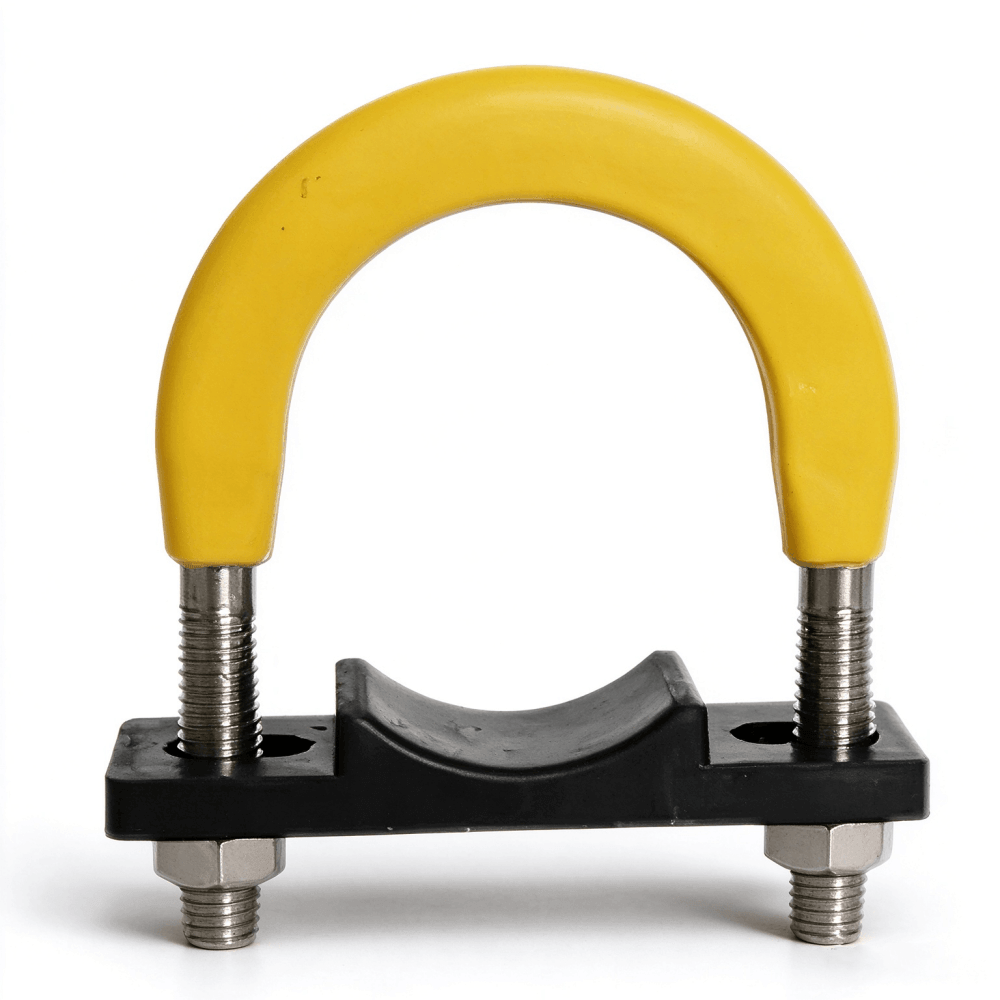
A flat or curved backing saddle spreads clamping force across the pipe surface. Without one, torque concentrates on two narrow contact lines, denting thin-wall pipe and creating stress points. Large-diameter lines need a curved saddle matched to the pipe OD.
Thread Form and Anti-Galling
Stainless threads gall easily, especially in salt service. Rolled threads outperform cut threads on fatigue strength and fit. Specify an approved marine anti-seize compound and a documented assembly procedure — ordinary grease washes out or traps grit.
Forged Versus Welded U Bends
One-piece hot-forged U bolts are stronger than welded ones. A weld introduces a corrosion and cracking point exactly where vibration load peaks. For load-bearing marine supports, specify forged construction.
Thread Length and Locking Hardware
Thread length must cover the full stack height of saddle, washers and nuts. For vibration, use lock washers, nylon-insert lock nuts, or double-nut locking. Engine-room piping deserves double nuts as standard practice.
Sizing, Load Ratings and Installation Rules
Size by Pipe OD, Not Nominal Size
Order against the measured outer diameter. Schedule, coating and liner all change the final OD, and a nominal-size mismatch is the most common cause of field rework.
Load Rating Must Include Shock and Vibration
U bolt pipe clamp for marine,Work from static weight, then apply the marine shock and vibration multipliers used by your project standard. Ask the supplier for a working load limit (WLL) per size and grade — never assume an onshore rating transfers to a vessel.
Support Spacing and Torque
Thin-wall plastic and GRP pipe needs closer spacing and lighter clamps. Heavy-wall metal seawater pipe allows wider spacing, subject to WLL. Torque to the manufacturer’s published value with a calibrated wrench: over-tightening crushes plastic pipe and liners, under-tightening lets the line move.
Fixed Versus Sliding Supports
Clamps can be configured as fixed or guided-sliding supports. Where thermal swing is significant, allow limited axial movement to prevent stress build-up at flanges and joints.
Certifications and Standards to Request
Confirm what your project or surveyor actually requires before quoting:
- ASTM A193 / A194 for stainless bolting
- EN 10204 3.1 material certificates with heat numbers
- ISO 9223 C5-M marine corrosivity compliance
- DNV, ABS or Lloyd’s Register type approval for commercial and offshore work
- CE marking for EU marine equipment
Note that classification approval is not standard on off-the-shelf clamps. If the survey requires approved supports, confirm the paperwork exists before you order — most generic fastener suppliers cannot supply it.
A Six-Step Sourcing Workflow
Step 1 — Fix the Application Parameters
U bolt pipe clamp for marine,Record pipe OD, pipe material, internal media, operating temperature, location (above water, splash, submerged), vibration level, target service life, classification requirements and design load. This single sheet prevents wrong quotes.
Step 2 — Select Alloy and Liner
Apply the corrosion and fluid-compatibility rules above, and build a galvanic compatibility list for every metal in the assembly.
Step 3 — Request Drawings, WLL Data and Certificates
Serious suppliers send dimension drawings, load tables and material certificates. Traders send photos.
Step 4 — Test Pre-Production Samples
Fit the sample to your actual pipe. Check OD match, thread engagement, liner bonding, saddle curvature and marking. This is where OD mismatches and poor rubber bonding surface.
Step 5 — Agree Lead Time, MOQ and Packaging
Duplex, super duplex and nickel alloys run longer than standard fasteners. For export, specify individual wrapping, desiccant, sealed cartons and crates — surface staining in transit is a real rejection cause.
Step 6 — Inspect on Arrival
Check for pitting, liner delamination, thread damage and marking; cross-check MTR chemistry against the delivered parts.
Ten Mistakes That Repeat Across Projects
- Buying “marine” clamps with no material certificate.
- Mixing dissimilar metals and creating a galvanic cell.
- Using bare bolts without liners.
- Calculating only static weight and ignoring shock load.
- Treating the salt spray zone as low-risk.
- Ordering by nominal pipe size instead of OD.
- Selecting liners incompatible with oil or heat.
- Skipping lock nuts in high-vibration locations.
- Ignoring classification approval requirements.
- Using welded U bends for load-critical supports.
FAQ
Can 316L clamps be fully submerged in seawater?
Intermittent and splash exposure is fine. Continuous, stagnant submersion eventually causes crevice corrosion; use 2205, 2507, Monel or titanium for permanent submerged supports.
U bolt clamp or pipe saddle — what is the difference?
A U bolt clamp uses a U-shaped bolt to pull a saddle tight against the pipe for mounting to frames and stanchions. A saddle alone has no fastener assembly.
How often should marine clamps be inspected?
Annually at haul-out for recreational craft; per survey schedule for commercial and offshore assets. Look for rust staining, liner cracking, loose nuts and pipe movement.
Can I paint stainless clamps for extra protection?
Generally no. Paint traps salt moisture and hides crevice corrosion; once it chips, attack accelerates underneath. Alloy selection is the reliable fix.
Is duplex worth the premium over 316L?
When downtime, labor and pipe-damage risk are high, yes. The higher unit price is usually recovered in the first avoided replacement.
Final Thoughts
U bolt pipe clamp for marine carry outsized responsibility for saltwater piping reliability. Treating them as commodity fasteners is how corrosion failures, survey holds and onboard repairs begin. Define the environment, choose the alloy and liner deliberately, verify the documentation, validate a sample, and plan for vibration and chloride exposure.
Whether you are outfitting a superyacht, building a workboat, upgrading platform piping or designing an aquaculture line, this framework lets you brief suppliers precisely — and filter out the ones who cannot prove what they sell.

